
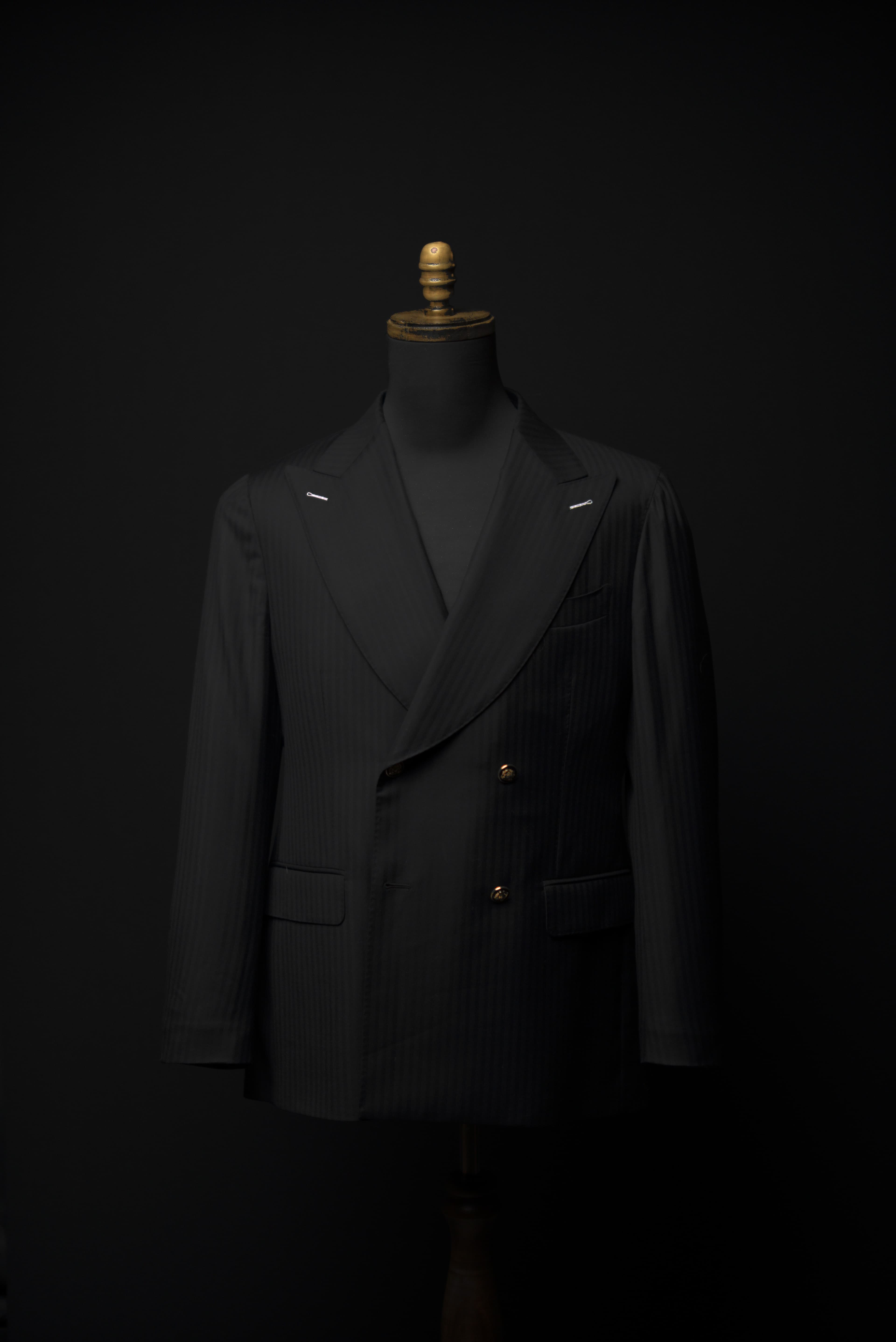
Holland and Sherry is the cloth to reach for when you want a suit that holds its shape, takes daily wear, and still looks right years from now. It is British worsted, firmer and more structured than the soft Italian cloths most men picture when they think of fine tailoring. That structure is the whole point. Here is when it is the right call for your commission, and when it is not.
The hand is the story.
Holland and Sherry is a British cloth house with a long heritage and one of the deepest ranges in the trade. For what you actually care about, the catalog is not the story. The hand is.
Pick up a length of their worsted and you notice it in your fingers before your eyes catch up. There is body to it. It has a backbone that a soft flannel does not. Where a featherweight Italian cloth pools and drapes, a Holland and Sherry worsted stands up, takes a fold, and keeps it. That is not a small thing. Most of what makes a suit look right a year in, and not just the week you collect it, comes down to whether the cloth was built to hold a shape or built to feel soft on the rack.
Both have their place. But they are not the same tool, and a good commission starts with knowing which job you are hiring the cloth to do.
The real test is year three.
I see cloth do its real work in three places. On the bench while I am building the suit. At the delivery fitting when you put it on. And then two or three years later, when a client comes back for something new and I get to look at how the first suit held up. That last look tells me more than the first two combined.
Holland and Sherry tailors clean. It takes a pressed edge and keeps it. The lapel rolls where you set it instead of where it feels like going. The trouser crease holds through a day of sitting and standing without going slack by lunch. When I build shape into a jacket, a chest with a little life in it and a shoulder that sits square, this cloth carries that shape instead of fighting me for it. Softer cloths can look beautiful, but they ask the man inside to be the structure. This one does some of that work for you, which is a gift on the days you are tired and the suit still has to look like you are not.
Then there is wear, and this is where the cloth earns its keep. A suit that goes into rotation three or four days a week lives a hard life. It sits in chairs, rides in cars, gets carried over a shoulder through airports and parking garages. The places a suit gives out first are the seat, the knees, and the elbows, and the way it gives out is shine and bagging. A firmer British worsted resists both for longer. The weave is doing more to hold the cloth together, so it keeps its surface and its line past the point where a softer cloth has started to look tired and slept in.
When a client tells me a suit still reads sharp in its fourth year, it is almost always cloth like this underneath. That is the quiet math nobody talks about in the shop. The real cost of a suit is not the sticker. It is the sticker divided by how many times you wear it before it stops looking right. A commission you reach for twice a week for five years is one of the cheapest things in your closet by that measure, and the cloth is most of what decides whether you get there.
For the suit that has work to do.
Reach for it when the suit has work to do.
If you are in front of people for a living, presenting in a boardroom, standing at the front of a courtroom, working a sales floor, or in the pulpit on a Sunday, your suit is part of how you are read before you open your mouth. You want it to look deliberate, hold its line through a long day, and never betray the miles on it. That is the brief Holland and Sherry was made for. For the man building a real working wardrobe, the kind we map out together on the executive wardrobe side of the business, it is often the first cloth I put on the table.
It also fits the way people actually move around here. A client running between meetings in downtown Sacramento and a site visit across the county needs one suit that does both without a change of clothes. A cloth with this much backbone travels well, shrugs off a day in the car, and is ready again the next morning with nothing more than a quick steam. Structure is not only about looking sharp standing still in a mirror. It is about looking sharp after the day has happened to you.
There is a quieter case for it too. If you are buying your first serious suit, the one you will lean on while the rest of your wardrobe catches up, durability matters more, not less. You are going to ask that one suit to do everything for a while. A cloth that holds up under heavy rotation is exactly what you want underneath your first suit, because it has to carry you until you can add the second and the third.
And it is simply the right call when you want the thing to last. If you plan to own a suit for years, the small difference between a cloth that wears hard and one that does not vanishes against the wear you get back out of it.
The honest other side.
I would rather lose a sale than put you in the wrong cloth, so here is the honest other side.
If you run hot, or you are buying for the middle of summer, a firmer worsted can feel like more than you want against the skin. There are lighter and more open Holland and Sherry cloths that take some of the edge off that, but if breathability and lightness are the entire brief, I may point you somewhere else and be glad I did.
If what you are after is pure drape, that soft, fluid, almost liquid fall you see on a relaxed unstructured jacket, a firm British worsted is not the shortest path there. That look comes from a softer cloth and a softer make working together, and trying to force it out of the wrong cloth just frustrates everyone in the room.
And for a once a year occasion suit, the whole equation shifts. If you want one beautiful thing for a summer wedding at a wine country venue, where you will wear it for an afternoon and the light is doing half the work, I will often reach for something lighter and softer with a bit more sheen and a lot more drape. A suit that has to survive a hundred ordinary wears and a suit that has to be perfect for one extraordinary afternoon are not the same suit, and they are not always cut from the same cloth.
Knowing which is which is most of the job. The cloth is a tool. The right one depends entirely on the work you need done.
Two questions: weight and finish.
The Holland and Sherry range is deep, and you can see the house and the bunches we work from on the Holland and Sherry cloth page. In the workroom, though, the choice almost always narrows to two questions: weight and finish.
Weight is about season and use. A mid weight cloth, the kind that works nearly all year in our climate, is the workhorse, and it is what most working wardrobes get built on. Go heavier if the suit is mostly for cooler months or you want the maximum in structure and durability. Go lighter and more open if you want some of that backbone without carrying the heat through July.
Finish is about how the suit reads in a room. A flatter, tighter finish reads formal and businesslike, and it is the safe heart of a professional wardrobe, the navy and the charcoal you reach for without thinking. A little more texture, a touch of openness in the weave, reads slightly softer and more personal. That is the one I steer a man toward when he already owns the plain workhorses and wants the next suit to carry a bit more of him in it.
You do not need to learn any of this before you sit down. Sorting it out is my job, not yours. But it helps to walk in knowing the choice is not random and it is not a contest to pick the most expensive cloth in the book. It is about matching the cloth to the life the suit is going to live.
Habits that double the life.
The cloth gives you a head start on longevity. The rest is how you treat the suit, and a few habits roughly double the life of any commission. They matter most on the one you wear hard.
Rest it between wears. A suit worn two days running never recovers the way one that gets a day off does. Wool needs time to relax back into shape and shed the moisture of a day on the body. If this is going into heavy rotation, that is the real argument for owning two suits instead of one. Not vanity, recovery.
Steam more than you dry clean. Most of what makes a suit look tired is wrinkles and odor, and steam fixes both without the harshness of solvent. Save the cleaner for actual stains and the end of a season, not the end of a week.
Hang it on a shaped wood hanger with room to breathe. Crushed into a packed closet, even the best cloth creases where you do not want it to. Holland and Sherry holds its shape better than most, but it is not magic. Treat the suit like it is built to last and it will return the favor.
What I would put my own money on.
When a client asks what I would put my own money on for a suit I had to wear hard and keep for years, this is usually where I land. Not because it is the softest thing I can hand you, it is not, but because it does the one thing I most want a working suit to do. It still looks like it means business long after the newness has worn off.
"That is the only test that counts. Not how a suit feels in the shop on the first day. How it reads in year three."
What clients ask about Holland and Sherry.
- Is Holland and Sherry good cloth for a suit?
- Yes, especially for a suit you will wear hard. Holland and Sherry is a British worsted with the structure to hold its shape and resist shine and bagging through years of regular wear, which is exactly what a working suit needs.
- Should I choose Holland and Sherry or a softer Italian cloth?
- Choose Holland and Sherry when the suit has to work and last, through daily wear, long days, and years of rotation. Choose a softer Italian cloth when you want drape and lightness for an occasion or for warm weather. They are different tools for different jobs.
- Is Holland and Sherry too heavy for year round wear in Sacramento?
- Not if you pick the right weight. A mid weight Holland and Sherry works nearly all year in our climate, and lighter, more open cloths in the range take the heat off for high summer without giving up much structure.
- How much does a Holland and Sherry suit cost?
- A custom suit at Crowned Legacy runs $1,800 to $3,500 depending on cloth and construction, and Holland and Sherry sits within that range. Commissions in Holland and Sherry cloth start at $2,000. The exact figure depends on the bunch and weight you choose, and it is set at the consultation with no surprise charges.
Where to start.
If you have a suit that needs to work for a living, this is a cloth worth talking through in person. Bring me the brief, how often you will wear it, where, and what it has to do, and I will lay out the Holland and Sherry options that fit, along with anything else that might serve you better. The consultation is on me, the fitting comes to you, and the suit is built to your measurements and delivered in 4 to 8 weeks.
Book a consultationSacramento · Bay Area · 916.520.4106 · By appointment only
Where this article connects on the rest of the site.
- The full Holland and Sherry mill pageThe dedicated mill register page on /cloth. Bunches, weights, and the commission framing across the British worsted library.Read on
- Executive wardrobe planningWhere the Holland and Sherry commission sits inside a multi piece executive book. Worsted backbone for the daily business rotation.Read on
- Wedding suits in Wine CountryThe Napa and Sonoma venue calendar where cloth choice tips toward Italian softness more often than British structure. The trade off explained.Read on
- Mobile concierge in SacramentoThe downtown Sacramento service register. Fittings at your office or home on the standard Tuesday through Thursday rotation.Read on
More from the journal.
When to choose Dormeuil
A French house, woven in England. The price buys cloth character, not a finer number.
Read the articleWhen to choose Lanificio Cerruti
Gruppo Piacenza owns both mills. The price gap is not the badge. It is the fiber.
Read the articleThe Loro Piana commission, what to know before you choose Super 150s
Loro Piana is the Italian cloth maker founded 1924 in Quarona, Piedmont. Tasmanian Super 150s anchors the four season Italian register; Wish Super 170s sits a step finer; vicuna and baby cashmere sit in their own tier. Commissions in Loro Piana cloth start at $5,000, at the bespoke tier, above the $1,800 to $3,500 range where most Crowned Legacy commissions land.
Read the article