
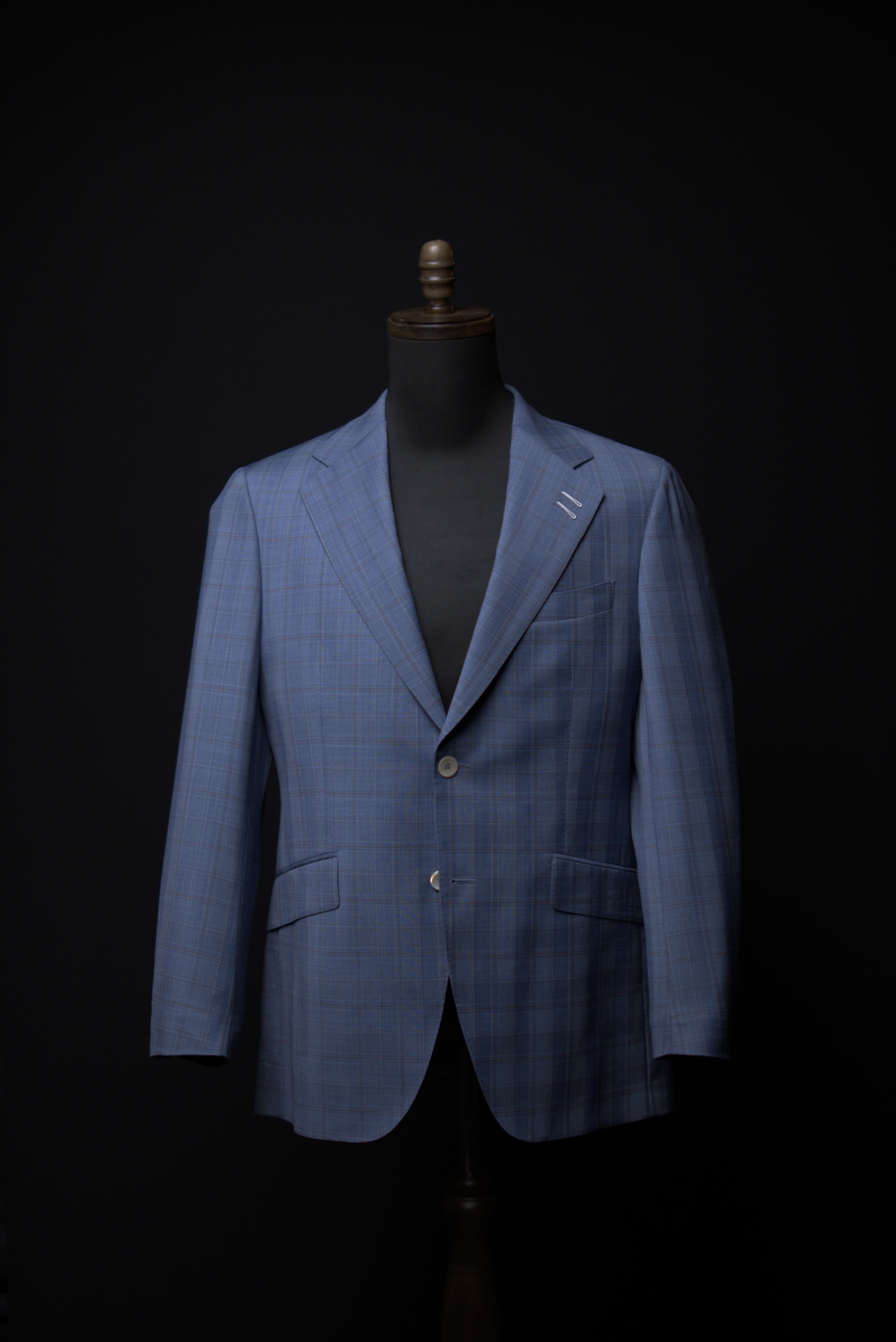
Dormeuil is a cloth house founded in Paris in 1842 by Jules Dormeuil, and it has been run by the same family since. What surprises most clients is where the cloth is made. Dormeuil designs in Paris and weaves in Huddersfield, in West Yorkshire, the English town that has produced fine worsted for centuries. Crowned Legacy commissions Dormeuil cloth starting at $3,000. That is the third rung, above the Italian mills that suit a first commission, and this is what the money buys.
French address, English loom.
Jules Dormeuil was twenty-two when he started the business in 1842, and he started it backward. Most cloth houses grow from a mill. Dormeuil grew from an idea: that French buyers wanted the best English cloth, and that someone should bridge the Channel to bring it to them. He imported English worsted into Paris, his brothers joined him, and the family crest still carries three rams' heads for the three of them.
That founding shape never changed. Dormeuil is French by address, ownership, and sensibility, with its head office outside Paris. But the cloth is woven in England, in Huddersfield, and has been for generations. When you commission Dormeuil, you are buying a French house's eye applied to an English loom.
This is why Dormeuil sits with the register heritage mills rather than the Italian ones. Scabal weaves in Huddersfield too, and Holland and Sherry books Yorkshire cloth from Peebles. Dormeuil is the French member of that English weaving tradition, which is a genuinely unusual thing to be.
Tonik, and the shimmer.
If you know one Dormeuil cloth, it should be Tonik.
Dormeuil introduced Tonik in 1957. It is a mohair and wool blend, and it did something pure worsted could not: it held a crisp, clean line with a faint shimmer under light, and it resisted the wrinkle and the sag that a long day puts into a soft cloth. Tonik became the cloth of mod era tailoring, the sharp suit of the nineteen sixties, and it is still in the book.
The reason it matters for a commission today is the same reason it mattered then. Mohair is a firmer, more resilient fiber than wool alone. Blended into worsted, it gives the cloth a backbone. A Tonik suit reads sharp rather than soft, throws light differently than a matte worsted, and keeps its edge through wear. It is not for every man and not for every occasion, which is exactly why it is a decision rather than a default.
Sportex is the other heritage cloth, the original sport coat fabric Dormeuil introduced in 1922, and the first to use a woven selvedge to stop the edge fraying. Between them, Tonik and Sportex are what Dormeuil is known for, and neither has an Italian equivalent.
Amadeus, the cloth that survives the travel week.
Where Tonik is a statement, Amadeus is the workhorse.
Amadeus is Dormeuil's performance flagship, and it is pure extra fine Merino wool, woven at a substantial 310 grams and finished by processes Dormeuil keeps to itself in its English mills. What the finishing buys is recovery. The cloth handles a long travel day and comes back overnight without surrendering its register, which is why it has a place in the wardrobe of the executive who lives on planes.
Notice what Amadeus is not. It is not a rare fiber play and it is not a summer weight. Its distinction is the finish, not the composition: a plain, honest wool that the English finishing transforms. That is the Dormeuil signature in miniature.
The two mills that weave where Dormeuil does.
Huddersfield is to English worsted what Biella is to Italian. For two centuries the town and the Colne Valley around it have woven fine suiting, and the water and the accumulated craft are the reason two of the twelve mills in the Crowned Legacy library weave there rather than anywhere else.
Dormeuil and Scabal both draw on that tradition, and they are not interchangeable. Holland and Sherry books from it without weaving, running the structured British worsted and the dinner jacket cloths as a merchant house. Scabal reaches into bold pattern and the very high Super numbers. Dormeuil brings the French eye and the specialty cloths, Tonik and Sportex, that the others do not make.
Choosing among the Huddersfield houses is not choosing a country. It is choosing whose judgment you want applied to the same English weaving heritage.
What the third rung buys.
Dormeuil starts at $3,000. The Italian mills that suit a first commission start lower: Vitale Barberis Canonico and Reda at $1,500, several others at $2,000. So the honest question is what the extra buys.
Not a finer Super number. A Super 150s from a $1,500 mill and a Super 150s from Dormeuil are both Super 150s. What you are paying for at $3,000 is cloth character and finishing: the mohair backbone of Tonik, the recovery of Amadeus, the specialty bunches that only exist because a French house spent a hundred and eighty years developing them and an English mill spent as long learning to finish them.
That is a real thing to buy, and it is also the wrong thing to buy first. A man's first suit should be a versatile worsted in navy or charcoal from a mill that does that job cleanly and affordably. Dormeuil is a second or third commission, when the wardrobe already has its foundations and the next suit is allowed to have an opinion.
Where Dormeuil sits among the twelve.
The Crowned Legacy library holds twelve mills, and the floors describe what each mill's cloth is made from and known for, not a ranking.
Vitale Barberis Canonico and Reda start at $1,500. Holland and Sherry, Guabello, Carlo Barbera, and Lanificio Cerruti at $2,000. Scabal and Drago at $2,500. Dormeuil, Zegna, and Loro Piana at $3,000. Fratelli Piacenza at $4,000.
Dormeuil shares its rung with Zegna and Loro Piana. Dormeuil and Zegna make a useful contrast. Zegna is Italian, vertically integrated, built for the boardroom worsted that holds a crease through a long day. Dormeuil is French designed and English woven, built for cloth with character: shimmer, backbone, heritage. Same floor, different reason to be there.
Sam on the cloth.
"Tonik is the cloth that defined mod era tailoring. The mohair and wool blend carries a crispness that pure worsted at the same weight cannot reach, and the shimmer under light is the part you cannot describe until you put it on. Sportex is the sport coat heritage cloth; Dormeuil introduced it in 1922 and the bunch still reads true to what the sport jacket is supposed to be."
When to choose it.
Choose Dormeuil when you want cloth with a point of view. The Tonik suit for the man who wants sharp and a little shimmer, not soft and matte. The Amadeus commission for the executive whose suit has to survive the travel week. The Sportex sport coat for the wardrobe that already has its business suits and wants a jacket with heritage in it.
Choose something else for a first suit, or when a versatile everyday worsted at a lower floor is the more honest answer to what the wardrobe actually needs.
Made to measure suits in Dormeuil cloth start at $3,000. Half canvas is standard, full canvas available. Bespoke starts at $5,000, full canvas always. Delivery is four to eight weeks for made to measure and three to six months for bespoke.
What clients ask about Dormeuil.
- Is Dormeuil French or English?
- Dormeuil is a French house, founded in Paris in 1842 by Jules Dormeuil and run by the same family since. Its cloth is woven in England, in Huddersfield, West Yorkshire. So it is accurately described as Franco British: French in design, ownership, and sensibility, English in weaving. That combination is what distinguishes it from the fully Italian mills and from the British houses.
- What is Tonik?
- Tonik is Dormeuil's signature cloth, a mohair and wool blend introduced in 1957 that defined mod era tailoring. The mohair gives it a crispness and a faint shimmer under light that pure worsted cannot reach, along with resilience through a long day. It reads sharp rather than soft, and it has no direct equivalent among the Italian mills.
- What is Amadeus, and is it a wool and silk blend?
- Amadeus is Dormeuil's performance flagship, and it is pure extra fine Merino wool, not a wool and silk blend. Woven at around 310 grams and finished by processes unique to Dormeuil's English mills, its distinction is recovery and drape through a travel week rather than a rare fiber content. Dormeuil does make wool and silk cloths, but Amadeus is not one of them.
- What does Dormeuil cost, and is it worth more than a less expensive mill?
- Made to measure suits in Dormeuil cloth start at $3,000. The extra over a $1,500 mill does not buy a finer Super number, which is the same across mills. It buys cloth character and English finishing: the mohair backbone of Tonik, the recovery of Amadeus, and specialty bunches the Italian mills do not weave. For a versatile first suit, a lower floor is the more practical choice. Dormeuil rewards the second or third commission.
Where to start.
Every Dormeuil commission runs through the same mobile concierge model. Sam Cole brings the Dormeuil book to your home or office near you in Sacramento, in Roseville, and across the Bay Area. Made to measure in Dormeuil cloth starts at $3,000, and bespoke at $5,000. Four to eight weeks for made to measure, three to six months for bespoke.
Book a consultationSacramento · Bay Area · 916.520.4106 · By appointment only
Where this article connects on the rest of the site.
- The Dormeuil mill pageThe dedicated mill register on /cloth. The Tonik, Sportex, and Amadeus bunches, the Paris design office over the Huddersfield loom, and the commission framing from the house founded 1842.Read on
- Executive wardrobe planningWhere the Dormeuil commission enters the book, after the worsted foundation, when the next suit is allowed to have an opinion.Read on
- The Scabal mill pageThe other Huddersfield weaver in the library. Brussels design over an owned Yorkshire mill, bold pattern, and the very high Super numbers.Read on
- Mobile concierge in RosevilleThe Roseville service register. Fittings at the home, the office, or the club, by appointment.Read on
More from the journal.
When to choose Lanificio Cerruti
Gruppo Piacenza owns both mills. The price gap is not the badge. It is the fiber.
Read the articleHolland and Sherry: the cloth for a suit that has to last
Holland and Sherry is the British worsted to choose when you want a suit that holds its shape and takes daily wear for years. When it is, and is not, the right call.
Read the articleThe Loro Piana commission, what to know before you choose Super 150s
Loro Piana is the Italian cloth maker founded 1924 in Quarona, Piedmont. Tasmanian Super 150s anchors the four season Italian register; Wish Super 170s sits a step finer; vicuna and baby cashmere are priced by quote. Commissions in Loro Piana cloth start at $3,000 at the made to measure tier and $5,000 at the bespoke tier.
Read the article