
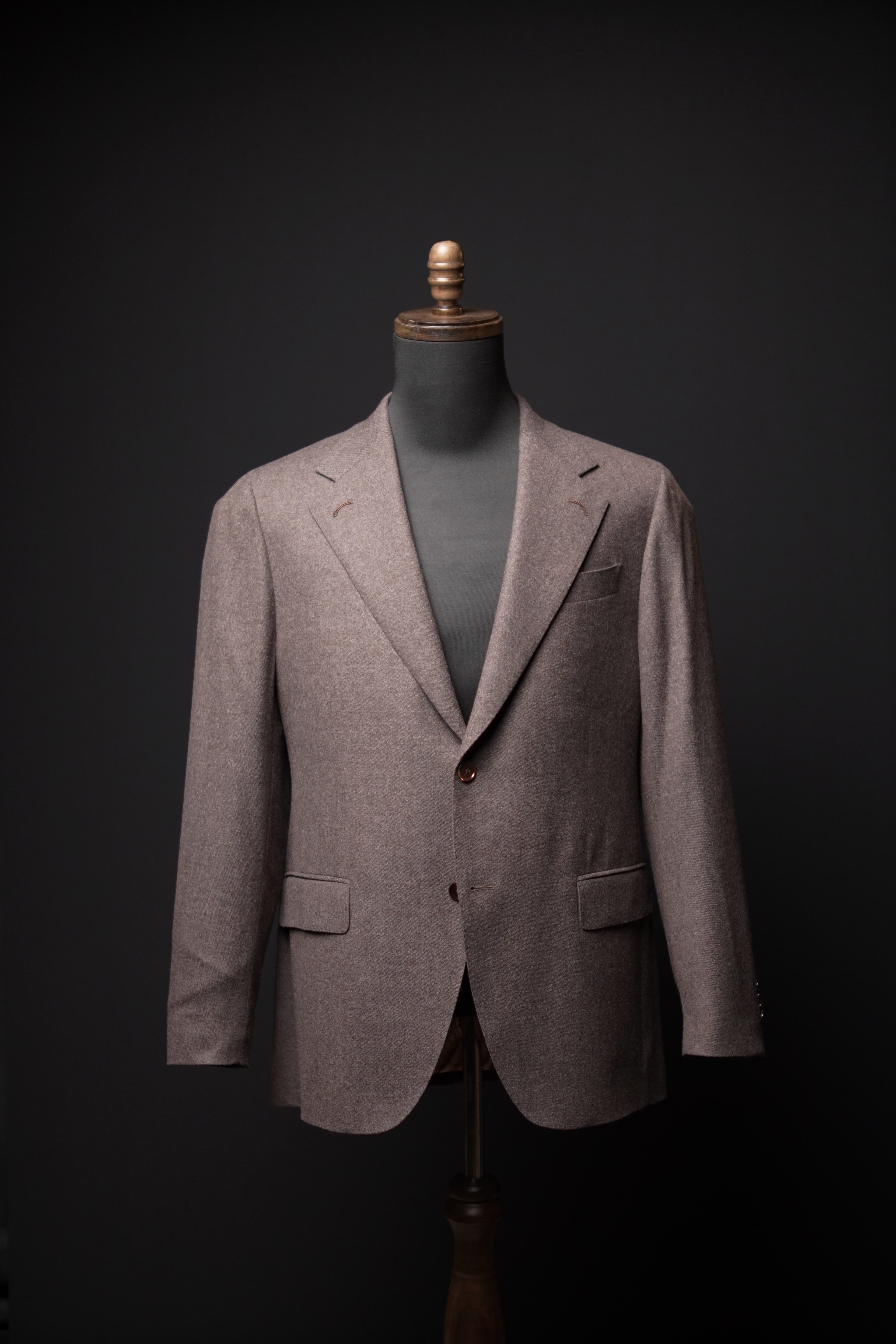
A suit can be your size and still not fit you. Five checks show the difference: the shoulders, the collar, the buttoned front, the sleeves and the trouser length. They are the first things Sam looks at, and you can check all five at a mirror.
Off the rack suits are cut for a standard body, and these five places are where a standard body and yours part ways. None of it means you chose badly. But once you know what to look for, you cannot unsee it.
1. Shoulders
Stand with your arms at your sides and look at the top of the sleeve, just below the shoulder. It should run smooth. A dent or ripple there, standing still or when you lift your arm, usually means the shoulder is too big for you. Cloth bunching near the armpit points the same way: the shoulder and the armhole sit in the wrong place for your body.
Shoulders come in many shapes: flat, steeply sloped, uneven from one side to the other, and different at the front than at the back. Off the rack jackets often cover the difference with thick pads. A custom jacket starts from your shoulders instead, with a light pad or none, and you decide how they read: a classic business shoulder or a soft one, shoulders that stand out or shoulders that stay quiet.
Can a tailor fix it? Rarely well. It takes a very experienced alteration tailor, and even then it often does not look right.
2. The collar
Look at the back of your neck in a second mirror, or ask someone to. The jacket collar should sit flat against your shirt collar. Watch for two problems: a gap, where the jacket collar stands away and the base of the shirt collar shows, and a roll, where the cloth bunches just below the jacket collar. Both usually come from the slope of the shoulders. Sam's own jackets need about a centimeter taken out at the collar to stop that roll.
Can a tailor fix it? A very experienced one can take the collar off and lower it, but there is a real risk it will not come out well. Cut right from the start, the problem never comes up.
3. The front, buttoned
Fasten the right buttons first. On two buttons, fasten the top one. On three, the top two, never the bottom. On a jacket with a single button, which reads dressier, fasten that one. Sam usually recommends two.
Then look at the button. It should not press a dent into the cloth, and no creases should pull toward it. Tension there means the jacket is working too hard: it is too small.
Below the button, the fronts should stay close, in line with the lower button and its stitching, or open just enough to show half of that button. If they flare wide apart, the jacket is too tight through the seat.
4. Sleeves and shirt cuff
With your arms relaxed at your sides, a quarter to half an inch of shirt cuff should show below the jacket sleeve. Sam likes about a quarter of an inch. With cufflinks, half to three quarters of an inch is fine. That part is your preference.
Sleeves are harder than they look. It is common for one arm to be a quarter to half an inch longer than the other, and posture changes how a sleeve hangs: an upright chest or a relaxed one, arms that sit slightly forward or back or rest slightly bent, an upper back that curves forward. Sleeve length also depends on the shoulder it hangs from, so the two are cut together. Sam measures both arms and allows for how you stand.
5. Trouser length
There is no single right length. No break, a quarter break, a half break and a full break are all choices, and so is the leg opening, wider or more tapered, which also depends on your build. A classic slanted hem just touches the top of the shoe in front and falls toward the back of the heel; it needs a wider leg to work.
Two things matter more than the choice. First, the trousers should sit at your waist where you want to wear them. Trousers that sit lower than you like, because that is where they fit, throw the length off. Second, the length is set with the shoes you will wear. Since Sam comes to you, have those shoes out when he does. If you wear two pairs, he will show you the difference.
If Sam could fix one thing
On an off the rack suit, Sam would fix the taper first. A suit should not look baggy or boxy, and it should not hover off you. It should follow your build: a V shape if you train, a slimming line if you do not. That does not mean skin tight. A suit that tries too hard looks it. A good suit is comfortable, moves with you and says you know what you are doing.
For your wedding
Comfort and a proper fit come first. It is the biggest day of your life, you will be moving and dancing, and you will probably be warm, so the cloth has to breathe and the suit has to move with you. Then the photos: nothing baggy, sleeves that sit right with your watch, trousers that do not pool at your shoes or end up under your heel when you dance, a vest that stays put, and a taper that flatters your build.
FAQ
- How much shirt cuff should show below a jacket sleeve?
- About a quarter to half an inch with your arms relaxed. Sam likes about a quarter of an inch. With cufflinks, half to three quarters of an inch is fine.
- Can a tailor fix jacket shoulders that are too big?
- Rarely well. It takes a very experienced alteration tailor, and even then it often does not look right. The shoulders are the part of a jacket to get right from the start.
- What trouser break should I choose?
- Any of them: no break, a quarter, a half or a full break. First get the trousers sitting at your waist where you want to wear them, then set the length in the shoes you will wear.
If your suit missed a check or two, you did nothing wrong. You bought what looked best, and it may be a good suit. In Sam's words:
"Think of golf clubs. Your first set is fine, until you try a set fitted to you. After that, the first set never feels the same. Suits work the same way. Once you wear something that actually fits you, something that kind of fits is not good enough anymore."
Sam comes to your home or office for a 90 minute consultation, at no charge. He looks at what you already own and answers every question you have, including the ones you did not know you had. Made to measure starts at $999, and the cost page lays out every tier. For builds that never fit off the rack, start with the fit guides.
More from the journal.
What color suit looks good on me?
Start with what you already wear. Navy and gray for most offices, a tone on tone pattern when you want one step more, and white and light blue shirts underneath.
Read the articleWhen to choose Dormeuil
A French house, woven in England. The price buys cloth character, not a finer number.
Read the articleWhen to choose Lanificio Cerruti
Gruppo Piacenza owns both mills. The price gap is not the badge. It is the fiber.
Read the article